Pre-Writing Skills Every Child Should Build Before Learning Letters
- Posted by Rachael Hartless
- Categories Activities, Gross Motor development, Starting School, Writing
Pre-Writing Skills Every Child Should Build Before Learning Letters
As parents, it’s easy to think that learning to write starts with holding a pencil and forming letters. In fact, many of us have fond memories of tracing letters on worksheets or practising our names over and over again.
However, research and experience in Early Years education tell us that writing starts much earlier than that.
Before children can confidently form letters, they need to develop a wide range of physical, sensory, communication and coordination skills. These skills are often called pre-writing skills because they provide the foundation for successful writing later on.
Think of writing like building a house. Letters and words are the roof. Before you can build the roof, you need strong foundations underneath.
What Are Pre-Writing Skills?
Pre-writing skills are the abilities children develop before they begin formal writing.
These skills help children to:
- Control their bodies
- Use their hands effectively
- Coordinate movements
- Understand language
- Develop visual skills
- Create marks with purpose
When these foundations are secure, learning letters becomes much easier and far less frustrating.
The Physical Foundations of Writing
Many parents are surprised to learn that writing starts with the large muscles of the body rather than the small muscles in the fingers.
Core Strength
Children need strong core muscles to sit upright comfortably and maintain a stable position while writing.
Without good core strength, children may:
- Slouch
- Lean on the table
- Tire quickly
- Avoid mark making activities
Activities that support core strength include:
- Climbing
- Crawling
- Balancing
- Wheelbarrow walks
- Obstacle courses
- Animal walks
Shoulder Stability
The shoulder provides the stable base that allows the hand and fingers to move accurately.
Strong shoulders develop through:
- Hanging from monkey bars
- Painting on large surfaces
- Sweeping
- Carrying objects
- Throwing and catching
Wrist and Hand Development
Before children can control a pencil, they need opportunities to strengthen their hands and wrists.
Try:
- Playdough
- Pegs
- Tweezers
- Threading
- Building toys
- Squeezing sponges
The Sensory Foundations of Writing
Writing is not just about muscles. Children also rely on information from their senses to control movement.
Vestibular System (Balance and Movement)
The vestibular system helps children understand where their body is in space.
This develops through:
- Swinging
- Spinning
- Rolling
- Climbing
- Balancing
Research suggests that movement experiences support children’s ability to sit still, focus and coordinate their actions.
Proprioception (Body Awareness)
Proprioception tells us how much force we are using and where our body parts are without looking.
Children develop proprioception through:
- Pushing
- Pulling
- Carrying
- Jumping
- Climbing
These activities help children learn how much pressure to apply when using tools such as pencils and scissors.
The Coordination Foundations of Writing
Crossing the Midline
Crossing the midline means moving one side of the body across the centre line of the body.
Examples include:
- Reaching across to pick up a toy
- Drawing large figure eights
- Ribbon dancing
- Washing a window
Children who struggle to cross the midline may find writing across a page more difficult.
Bilateral Coordination
This is the ability to use both sides of the body together.
Children use bilateral coordination when:
- Cutting with scissors
- Holding paper while drawing
- Threading beads
- Opening containers
The Communication Foundations of Writing
One of the biggest misconceptions about writing is that it is only about forming letters.
Before children can write ideas down, they need ideas to communicate.
Children benefit from:
- Listening to stories
- Singing songs and rhymes
- Having conversations
- Retelling events
- Acting out stories
- Learning new vocabulary
After all, writing is simply a way of recording thoughts and ideas.
If a child has nothing to say, writing becomes much harder.
The Visual Foundations of Writing
Children also need visual skills to support writing.
These include:
- Tracking objects with their eyes
- Following lines
- Spotting differences
- Recognising shapes and patterns
Simple activities such as puzzles, matching games and spotting objects can help develop these skills.
Why Mark Making Matters
Before children write letters, they should have plenty of opportunities to make marks.
Mark making is any form of drawing, painting, scribbling or creating symbols.
Early Years guidance recognises mark making as an important stage in writing development because it allows children to:
- Experiment with movement
- Develop control
- Express ideas
- Build confidence
The goal is not to produce perfect letters. The goal is to develop the skills needed for letters later.
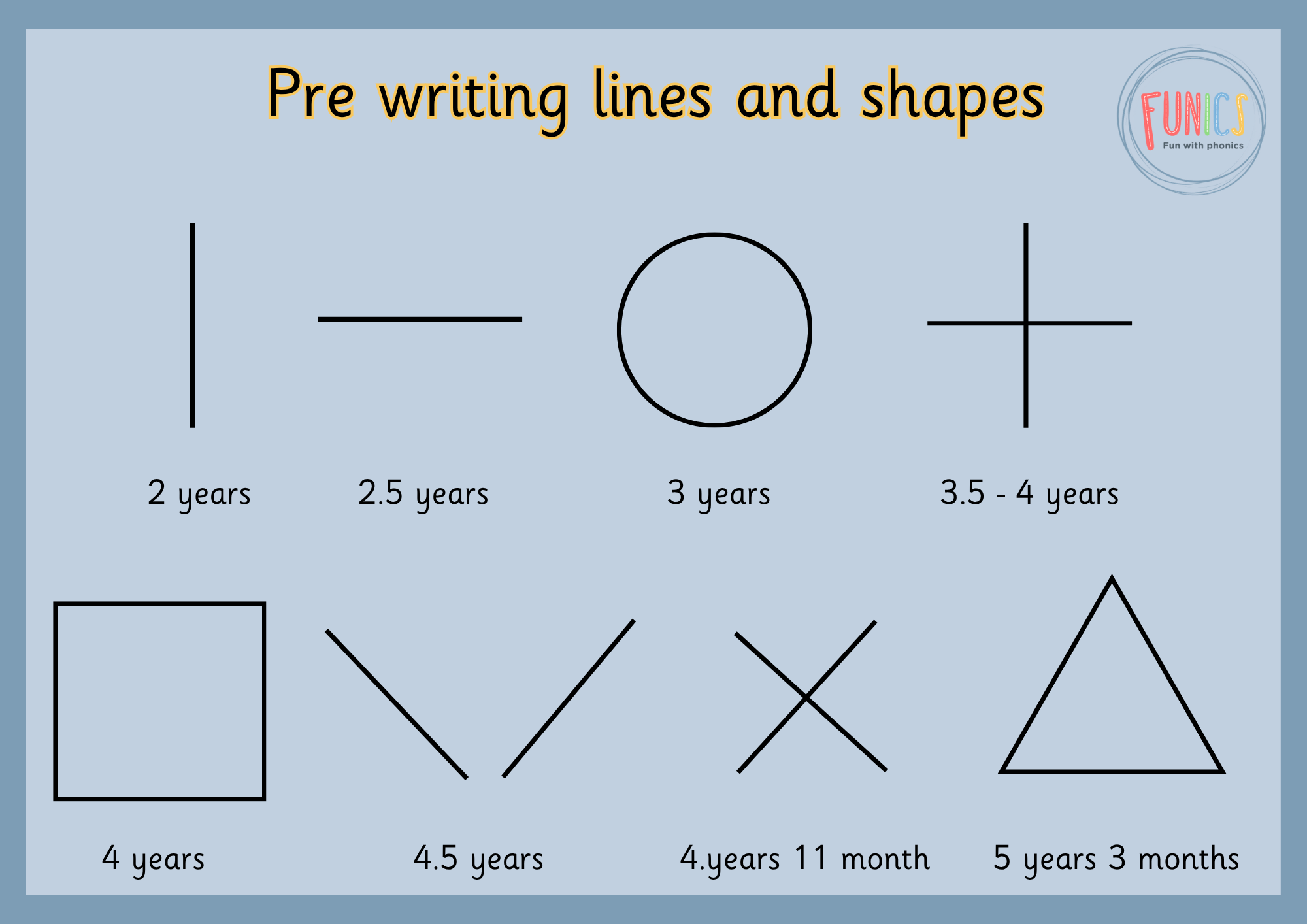
The Pre-Writing Lines and Shapes That Build Letters
Before children can form letters, they usually learn to make a range of lines and shapes. These become the building blocks for writing later on.
However, it’s important to remember that child development is not a checklist where every child follows exactly the same path. Children develop at different rates and may master some shapes before others.
Research and developmental guidance suggest that children often gain control over simpler shapes before more complex ones, but there will always be individual differences.
Vertical Lines
Often one of the first controlled marks children make.
You might see these appearing in:
- Rain pictures
- Tall towers
- Tree trunks
Horizontal Lines
As control develops, children begin making horizontal marks.
These appear in:
- Roads
- Fences
- Horizons
Circles
Circles are an important developmental milestone and form the basis of many letters and numbers.
Children often enjoy drawing:
- Faces
- Wheels
- Bubbles
- Suns
Crosses (+)
Children typically begin combining vertical and horizontal lines to create crosses.
You may notice this in:
- Road signs
- Treasure maps
- Simple people drawings
Diagonal Lines
Diagonal lines are often more challenging because they require greater control and coordination.
This is one reason many young children find certain shapes difficult at first.
For example:
- A child may draw a cross (+) instead of an X when asked to add a kiss to a card.
- A house may have a square body but no triangular roof.
- A child may avoid drawing sloping lines altogether.
This is completely normal.
Squares and Rectangles
As children’s control develops further, they begin joining lines together to create enclosed shapes.
Examples include:
- Windows
- Doors
- Boxes
Triangles
Triangles can be surprisingly difficult because they require children to combine diagonal lines accurately.
If your child’s house drawings have floating roofs, wobbly roofs or no roofs at all, they are not alone.
Many children need lots of opportunities to explore diagonal movements before triangles become secure.
Zig-Zags
Zig-zags require even greater control and planning.
You might see these in:
- Lightning bolts
- Dinosaur spikes
- Decorative patterns
Why This Matters for Letter Formation
Many letters are simply combinations of these basic lines and shapes.
For example:
- l, t, i use vertical lines.
- c, o, a use circular movements.
- v, w, x, y and z require diagonal lines.
When children struggle with certain letters, it isn’t always because they aren’t trying hard enough. Sometimes they are still developing the underlying movement patterns needed to create those shapes.
This is why plenty of opportunities for mark making, drawing, painting and large-scale movement are so valuable before expecting neat letter formation.
A Different Way to Think About Writing
One approach I use when supporting children is to think about writing as much more than holding a pencil.
Writing involves:
- Moving
- Exploring
- Talking
- Listening
- Building strength
- Developing confidence
This is the foundation of my W.R.I.T.E. Approach:
W – Working on vertical surfaces and using clear directional language
R – Refining motor skills and sensory development
I – Improving coordination
T – Talking, listening and building vocabulary
E – Exploring lines and shapes that become letters and numbers
That’s why activities on vertical surfaces, large-scale mark making, painting, chalking outdoors and sensory play can be just as important as practising letters.
In many cases, they are more important.
Simple Mark Making Activities to Try at Home
- Paint with water on fences and walls
- Draw giant shapes with chalk outdoors
- Make marks in shaving foam
- Draw in sand or soil with sticks
- Create roads for toy cars
- Use ribbon sticks to make shapes in the air
- Paint on an easel or vertical surface
- Make patterns with toy animals in playdough
- Draw giant circles using a paintbrush and water outdoors
- Create shape hunts looking for lines and shapes in the environment
These activities are fun, low-pressure and highly effective for developing pre-writing skills.
Final Thoughts
If your child is not yet interested in writing letters, don’t worry.
Writing is a developmental journey, not a race.
The strongest writers are not always the children who start letters earliest. Often they are the children who have had plenty of opportunities to move, explore, talk, play and make marks.
By focusing on these pre-writing foundations first, you are giving your child the best possible start for writing success in school and beyond.
If you’d like more simple, playful ideas to support your child’s early writing journey, keep an eye out for my upcoming Mark Making Activity Pack, packed with practical activities designed to build the skills children need before formal writing begins.
You may also like
What Makes a Sentence? How Colourful Semantics Helps Children Become Confident Writers
If I asked you, “What is a sentence?”, what would you say? It’s a question we were asked ourselves as teachers when we were learning about an approach called Colourful Semantics. Have a think before you read on! Many adults, …
Clap, Tap and Stomp: Fun Ways to Explore Syllables