Clap, Tap and Stomp: Fun Ways to Explore Syllables
- Posted by Rachael Hartless
- Categories Activities, phonics, Reading, Writing
Fun Ways to Teach Syllables Through Movement and Play
Have you ever noticed how naturally children clap along to songs, rhymes and funny words?
Without even realising it, they are beginning to hear syllables — the little beats inside words.
And those beats matter.
Syllable awareness is one of the early building blocks that helps children with reading, spelling and writing later on. The lovely thing is, children do not need worksheets or long explanations to learn it.
They can learn syllables by clapping, jumping, stomping, singing and playing.
At Funics, we believe children learn best when they can move, talk, listen and use their whole bodies. That is why our activities are designed to make early phonics playful, practical and easy to bring into everyday family life.
What Is a Syllable?
A syllable is a beat or chunk within a spoken word.
Each syllable contains a vowel sound, but the easiest way for children to understand syllables is to listen for the beats in a word.
For example:
- cat has one syllable: cat
- apple has two syllables: ap-ple
- elephant has three syllables: el-e-phant
It is important to listen to how the word sounds, rather than count the vowels you can see.
We are listening for the beats in the spoken word, not looking at how it is spelt.
Why Is Syllable Awareness Important?
Before children can confidently read and spell words, they need to understand that spoken language can be broken into smaller parts.
Syllable activities help children to:
- Listen carefully to words
- Recognise that long words contain smaller chunks
- Develop phonological awareness
- Break longer words into manageable parts
- Prepare for blending, segmenting, reading and spelling
For some children, hearing individual phonemes — the smallest sounds in words — can feel tricky at first.
Listening for larger syllable chunks is often an easier, more enjoyable place to begin.
Start With Your Child’s Name
Names are meaningful to children, so they are a brilliant starting point.
Say your child’s name slowly and clap each beat:
- Sam — one clap
- Ra-chael — two claps
- Ol-i-vi-a — four claps
Then try the names of family members, friends, pets or favourite characters.
You could even arrange photographs of the family according to the number of syllables in each person’s name.
Children are often fascinated to discover whose name has the most beats!
Try the Under-the-Chin Check
If your child finds clapping syllables tricky, ask them to place one hand gently underneath their chin.
Say the word slowly and clearly.
Each time their jaw moves down and touches their hand, they are feeling a syllable.
Try it with:
- dog
- ti-ger
- di-no-saur
- cat-er-pill-ar
This gives children a physical way to feel what their ears are listening for.
Make Syllables Move
Syllables do not always have to be clapped.
At Funics, we love adding whole-body movement because it helps children stay engaged and makes learning more memorable.
Choose a word and do one action for each syllable.
You could:
- Stomp
- Jump
- March
- Tap your knees
- Reach from side to side
- Bounce a ball
- Shake an instrument
- Tap rhythm sticks
- Perform a star jump
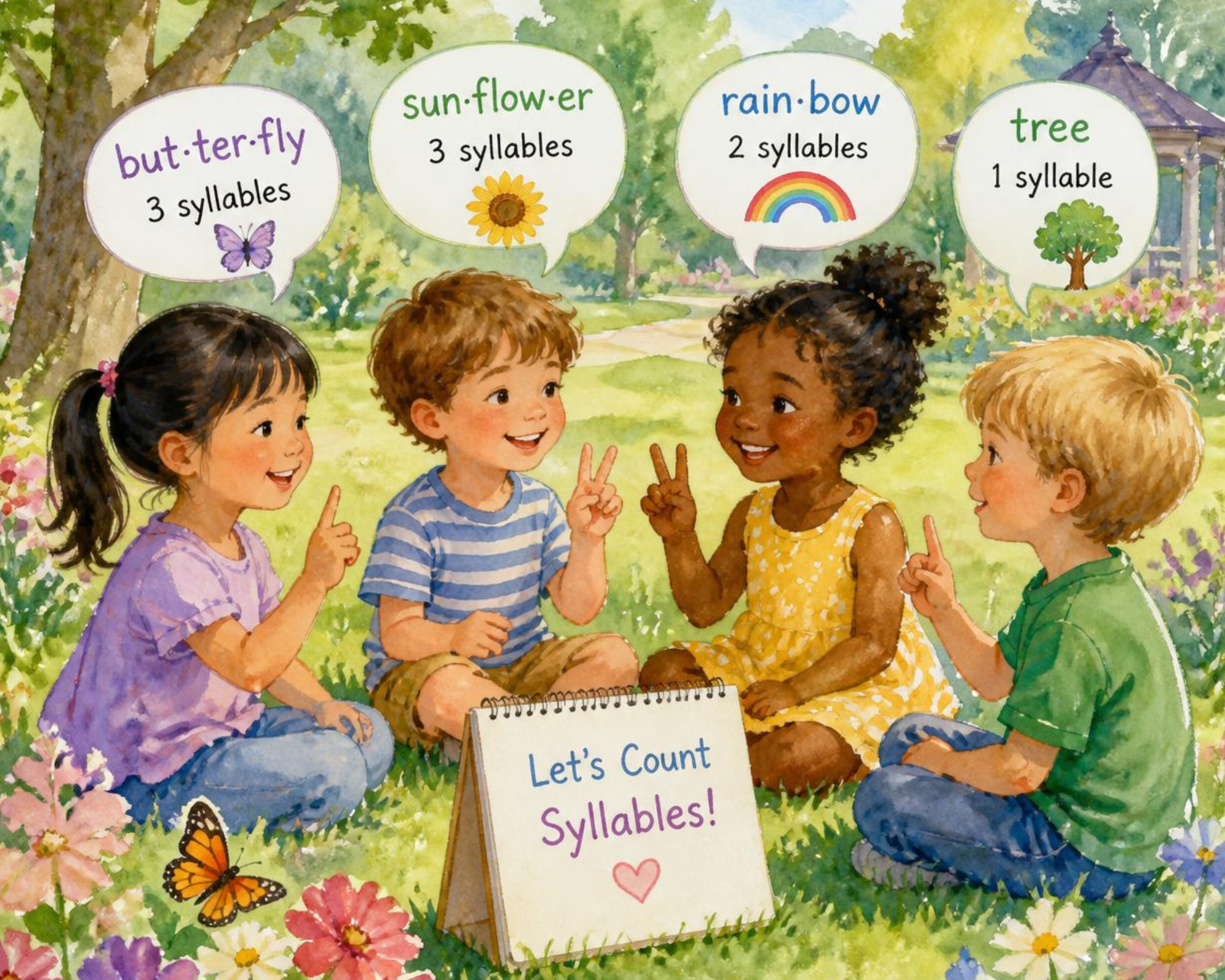
You might stomp el-e-phant, jump kan-ga-roo, or reach across your body three times for but-ter-fly.
Using movements that cross the middle of the body adds an extra coordination challenge too.
Want Activities Like This Planned for You?
This is exactly the kind of playful learning we love at Funics.
Our hands-on phonics boxes are designed to help children build early reading, writing, listening and language skills through movement, sensory play and practical activities — without making learning feel like schoolwork.
Take a peek at our Funics boxes if you’d like simple, ready-to-use activities delivered to your door.
https://funics.com/product/early-years-funics-abc-box-subscription/
Go on a Syllable Safari
Choose a room, the garden or a woodland walk and become syllable explorers.
Find an object, say its name, and work out how many beats it contains.
For example:
- leaf — one syllable
- flow-er — two syllables
- but-ter-fly — three syllables
You could collect safe objects, take photographs, or simply point to each discovery.
Then sort them into groups according to whether they have one, two, three or more syllables.
Remember to say the word naturally. If it is difficult to hear, say it again slowly without adding extra sounds.
Create a Syllable Movement Trail
Place three hoops, pieces of paper or chalk circles on the ground and label them:
1 syllable | 2 syllables | 3 syllables
Show your child a picture or object. Say its name together, count the syllables, and then ask them to travel to the correct place.
They could:
- Crawl to the one-syllable hoop
- Jump to the two-syllable hoop
- March to the three-syllable hoop
This combines listening, movement and decision-making — and it is much more exciting than sitting at a table!
Fill a Mystery Bag
Place a selection of familiar objects inside a bag.
Your child chooses one without looking, names it, and counts its syllables.
Try including objects such as:
- cup
- pencil
- teddy
- banana
- dinosaur
- caterpillar
After counting the beats, sort each object into a one-, two-, three- or four-syllable group.
For an extra challenge, give clues using syllables:
“I’m thinking of something with three syllables. You can eat it. It is yellow.”
Ba-na-na!
Make a Silly Syllable Band
Choose different actions to create body percussion.
For example:
- One syllable = clap
- Two syllables = tap your knees
- Three syllables = stamp your feet
- Four syllables = clap, tap, stamp and jump
Take turns choosing words and performing the correct action.
Let your child become the leader and test the grown-ups too — children love being the teacher!
Keep It Playful
Children do not need to master syllables in one session.
Short, playful experiences repeated during everyday activities are far more valuable.
Try counting syllables:
- While walking to nursery or school
- When putting away toys
- During story time
- When choosing food
- While singing songs
- When looking at animals in a book
You might clap to-ma-to while preparing lunch or stomp well-ing-ton boots before going outside.
When children can hear the rhythm and chunks within words, they are building strong foundations for later reading and writing — without the learning feeling like work.
And that is exactly how we like it at Funics: moving bodies, listening ears, talking voices and plenty of fun.
Want More Playful Phonics Ideas?
If you’d like more simple ways to support early reading, writing and phonics at home, our Funics boxes are created to make learning hands-on, joyful and easy to fit into family life.
Each box includes playful activities that help children explore sounds, words, movement, mark-making and early literacy skills with confidence.
Explore our Funics boxes and discover how phonics can feel like play. https://funics.com/product/early-years-funics-abc-box-subscription/
You may also like
What Makes a Sentence? How Colourful Semantics Helps Children Become Confident Writers
If I asked you, “What is a sentence?”, what would you say? It’s a question we were asked ourselves as teachers when we were learning about an approach called Colourful Semantics. Have a think before you read on! Many adults, …